

Short on time?
OBI, our AI assistant, gives you the key points of this article in a few lines.
OBI answers from this article only. It can make mistakes and is not financial, tax, legal or investment advice.
A private credit fund can have excellent credit judgment and still lose investor money through operational failure. The loan is underwritten correctly, the spread is real, and then the borrowing base is calculated off a stale file, the PIK toggle is boarded wrong, the lien lapses, or the waterfall pays the wrong tranche.
None of that is a credit problem. It is an operations problem, and operational due diligence in private credit exists to surface it before capital is committed.
This guide covers what operational due diligence in private credit means, where it diverges from the hedge fund and private equity templates most questionnaires were built around, the five pillars worth examining, how the checklist shifts by sub-strategy, and the red flags that should slow or stop a commitment.
What Operational Due Diligence Means in Private Credit
Operational due diligence is the non-investment examination of a manager: infrastructure, internal controls, governance, service providers, and operational maturity around committed capital. It asks whether the organization can do what it says it does, and whether the numbers reaching investors come from a process that survives scrutiny.
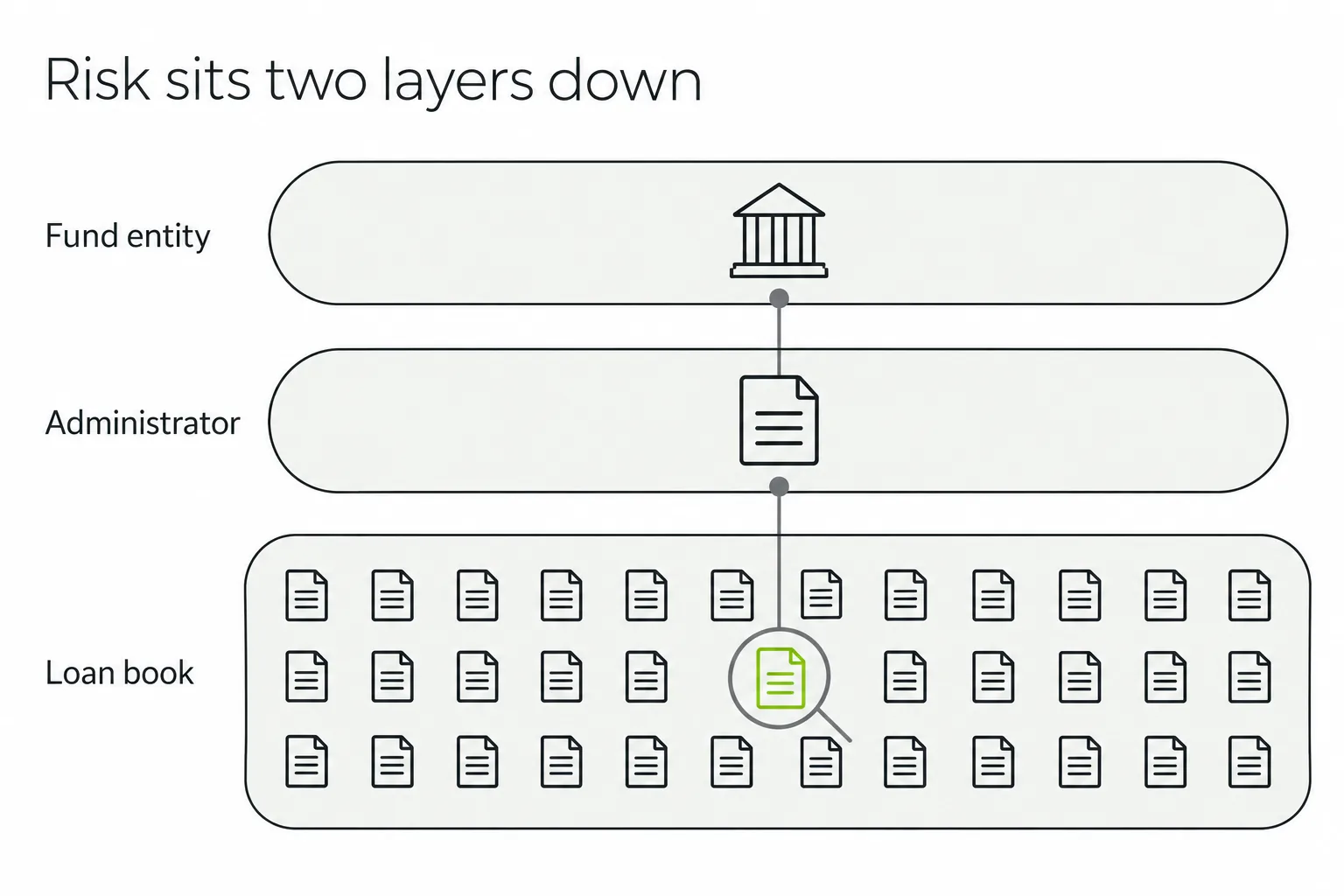
In private credit, the scope runs further than it does elsewhere. You are not only reviewing the fund entity and its administrator.
You are reviewing loan-level servicing, agency responsibilities, collateral monitoring, covenant tracking, and cash application across hundreds of positions with their own payment calendars. A fund can look clean at the entity level and still carry meaningful risk two layers down in the loan book.
ODD is run by institutional limited partners, investment consultants, funds of funds, foundations, and outsourced CIOs. It is increasingly run by general partners on themselves before a fundraise, because finding your own gaps costs less than having an allocator find them during a live process.
The two audiences want different things. The LP wants assurance that capital is safeguarded, that reported marks reflect reality, and that cash sits where the documents say it sits. The GP wants to clear diligence without rebuilding the back office mid-raise. Both end up looking at the same evidence.
One terminology note, because these words get used loosely.
| Term | What it covers |
|---|---|
| Middle office | Trade and loan capture, reconciliation, valuation support, reporting |
| Back office | Settlement, cash movement, books and records |
| Loan administration | Post-closing life of the credit: accruals, resets, amendments, borrowing base and covenant testing, agent duties |
| Calculation agent | Contractual role, usually in a structured facility, that produces the numbers driving payments |
| Transaction surveillance | Ongoing monitoring that flags when a deal drifts from its documented terms |
ODD vs. Investment Due Diligence: Where the Line Sits
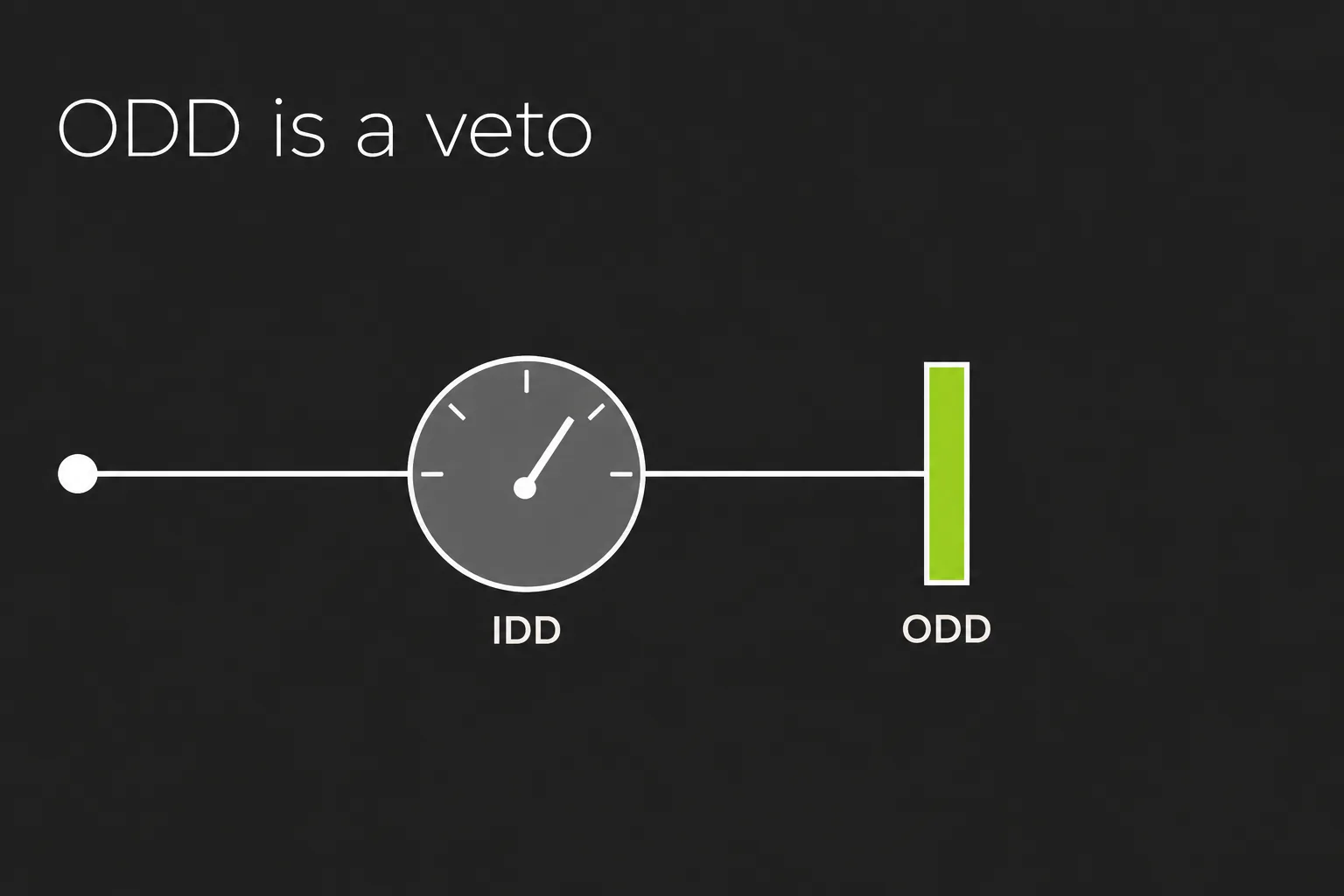
Investment due diligence asks whether the strategy makes money. Underwriting quality, credit selection, sourcing advantage, structuring discipline, spread capture, loss history against peers: that is IDD territory.
Operational due diligence asks whether the reported numbers are real and whether the cash is where it should be. Reconciliation discipline, valuation governance, lien perfection, waterfall accuracy, covenant tracking, and reporting integrity sit on this side.
| Investment due diligence | Operational due diligence | |
|---|---|---|
| Core question | Does the strategy make money? | Are the reported numbers real, and is the cash where it should be? |
| Focus | Underwriting quality, credit selection, sourcing, structuring, spread capture, loss history | Reconciliation, valuation governance, lien perfection, waterfall accuracy, covenant tracking, reporting integrity |
| Track record | Relies on it | Verifies the valuation controls behind it |
| Role in approval | Scoring input | Veto: a failed ODD is a hard stop |
The two overlap in one place that matters: track record. Verifying a track record depends on the valuation controls that produced it.
If ODD finds that marks were set by the same people who originated the loans, with no independent input and no documented non-accrual policy, the IDD conclusion built on that track record is worth less than it looked. ODD findings can invalidate IDD findings. The reverse is rare.
This is why large allocators run private credit operational due diligence as a veto function rather than a scoring input.
A fund can score well on strategy and fail on operations, and a failed ODD is a hard stop rather than a point deduction.
Treating ODD as a checkbox at the end of the process is how allocators end up in funds they would not have approved.
Why Hedge Fund and Private Equity Templates Fail Operational Due Diligence in Private Credit
Most ODD questionnaires in circulation were designed for a different asset class, and the assumptions embedded in them break quietly.
Hedge fund ODD assumes a prime broker, daily or near-daily marks, and an independent administrator striking NAV against observable prices. The core control is independent pricing against a market. Private credit has no equivalent. There is no price feed for a bilateral unitranche loan to a middle-market borrower.
Private equity ODD assumes a manageable number of portfolio companies and slow, event-driven cash movement: capital calls, a handful of investments, distributions on exit. The operational load is lumpy and concentrated around transactions.
Private credit sits between the two and inherits the hard parts of both. A single fund can hold hundreds of loans, each with contractual cash flows on its own calendar, none of which trade.
| Hedge fund ODD | Private equity ODD | Private credit | |
|---|---|---|---|
| Core assumption | Prime broker, near-daily marks, administrator strikes NAV | Few portfolio companies, slow event-driven cash | Hundreds of loans, each on its own payment calendar |
| Operational load | Daily | Lumpy, around transactions | Continuous: accruals, resets, PIK, fee amortization, OID, draws |
| Main control | Independent pricing against a market | Transaction-level review | The valuation policy itself, since none of the loans trade |
The operational load is continuous rather than event-driven: interest accruals, benchmark resets, PIK capitalization, fee amortization, OID accretion, scheduled amortization, delayed draw fundings, revolver draws and repayments, and the reconciliation work behind all of it.
Collateral is heterogeneous in a way that matters operationally. Receivables, inventory, equipment, real property, royalty streams, crop liens, and legal claims each require different monitoring workflows, data sources, and testing logic.
A system built for sponsor-backed cash-flow loans will not handle a merchant cash advance tape or a mortgage pool with escrow obligations.
Workout capacity is an operational question, not only a credit one. Restructuring a position requires amendment processing, revised amortization schedules, claims tracking, and often a wholesale change in how a position is carried and reported. Managers who have never worked out a deal tend to discover they have no process for it at exactly the wrong moment.
Pillar 1: Manager Infrastructure, People, and Governance
Start with the organizational chart, and read it for separation rather than headcount. Who originates, who operates, who controls the books, who values the assets, and where do those lines cross? The specific question worth asking: who can initiate a cash movement, who approves it, and can any single person do both?
Key person risk in operations is underexamined. Investment key person provisions get negotiated carefully in the LPA, and then the entire loan book turns out to depend on one operations lead who maintains the master spreadsheet. Ask what is documented and what is tribal knowledge. Ask what happens if that person leaves on Friday.
Headcount relative to loan count is a useful diagnostic. A team that has scaled by adding people rather than systems will show a roughly linear relationship between deals and operations staff, and that model breaks predictably as the portfolio grows or a new strategy is added.
Review the full service provider stack: fund administrator, auditor, custodian, fund counsel, deal counsel, loan agent, and any outsourced middle office or servicing provider. For each, ask how long they have been engaged, whether there have been changes, and why.
Where a function is outsourced, ask for the relevant SOC reporting and read it, including the complementary user entity controls the manager is expected to perform on its side. Those are frequently ignored.
Round out the pillar with the compliance program, code of ethics and personal trading, conflicts across funds and co-investment vehicles, the allocation policy and evidence it is followed, business continuity and cybersecurity, vendor oversight, and insurance coverage including errors and omissions, directors and officers, cyber, and fidelity bond.
Pillar 2: Valuation and Pricing Controls
Valuation is the hardest part of any operational due diligence in private credit review. Private loans are generally valued using inputs that are not observable in an active market. There is no exchange print to check against, which means the valuation policy itself is the control. If the policy is thin, there is no control.
Most private loans fall under private credit loan valuation Level 3, so every unobservable input behind a mark needs documented support.
Examine the valuation committee: who sits on it, how often it meets, what constitutes a quorum, and how independent it is from the deal team that originated the loan. A committee where the originating partner presents, discusses, and effectively decides is not a control structure.
Understand the third-party valuation arrangement precisely. There is a large difference between a full independent valuation, positive assurance on management’s marks, and a range review, and a larger difference still in how much of the portfolio is covered and how coverage rotates across quarters.
Managers sometimes describe all three as “independently valued.”
Test methodology consistency. Are discount rates derived the same way each quarter? Are recovery assumptions documented? When an input changes, is the change explained and approved, or does it appear quietly in the next mark?
Ask about the impairment and non-accrual policy: what triggers a downgrade, who signs off, and how quickly marks move after a covenant breach or a missed payment.
The most effective LP test here is sampling. Pick a loan and follow the mark from the source documents through the valuation model, the committee minutes, the administrator’s records, and into the investor statement.
Ask for stale-mark testing and a comparison of realized exits against the last carried value. If realizations consistently come in below the final mark, the valuation process has a directional bias worth understanding.
Pillar 3: Legal and Structural Integrity
Governing documents come first: the LPA, subscription documents, side letters, key person and removal provisions, the expense allocation policy, and clawback mechanics. Side letters deserve particular attention, since most-favored-nation terms and bespoke reporting requirements create operational obligations the back office may not know about.
Map the structure. Master-feeder arrangements, parallel vehicles, blockers, SPVs, and rated note feeders all change where a given loan legally sits and who has recourse to it. Ask the manager to show, for a specific loan, which entity holds it and how that flows to each investor class.
Then move to the credit and security documentation: lien verification, UCC financing statements and the process for tracking continuations, mortgage recordings where real property is involved, deposit account control agreements, and evidence that perfection was confirmed rather than assumed.
Review intercreditor and subordination agreements, and be clear on the distinction between acting as agent and being lender of record, because the operational duties attached to each are different.
Back leverage and subscription facilities deserve their own pass. What are the covenant terms, advance rates, eligibility criteria, and margin triggers? Critically, who calculates the borrowing base that determines availability, and is that calculation checked by anyone other than the person producing it?
Levered structures need the same discipline. See how NAV facility monitoring covers LTV, valuations, and covenants.
Finally, regulatory posture: registered adviser or exempt reporting adviser, and whether Form ADV disclosures are consistent with what the manager has represented to LPs.
For US lending strategies, state-level considerations matter too, including lender licensing requirements in particular states, usury exposure, and assignment restrictions that can limit transferability.
Pillar 4: Post-Closing Loan Administration and Servicing
Most private credit operational due diligence underweights this pillar, and it is where private credit breaks. The question is simple: who does the work after the wire goes out?
Loan boarding.
Economic terms have to be captured from the credit agreement into the system of record: rate, margin, floor, payment dates, amortization, fees, PIK mechanics, and covenant definitions.
Reliable credit agreement data extraction is what keeps those terms in the system of record matching the executed document.
Ask who performs boarding, who independently verifies it against the executed document, and what the error rate has been. Boarding errors compound silently for quarters.
Accrual mechanics.
Interest accrual conventions, benchmark resets and transitions, PIK capitalization, fee amortization, and OID accretion. Each is a place where a spreadsheet drifts from the document.
Recalculating OID is a good test: the OID amortization effective interest method is easy to get wrong in a workbook.
Borrowing base and eligibility testing.
How often is it run, where does the source data come from, who applies the exclusion logic, and how are ineligibles and concentration carve-outs handled? For asset-based facilities this is the central control, and it is frequently performed by the same team that wants availability to be high.
Concentration testing and collateral pool analysis.
Testing the pool against the facility’s limits, with documented results and an escalation path when a test trips.
Covenant compliance tracking.
Financial covenants, reporting covenants, cure rights, and what happens when a compliance certificate arrives late or does not arrive at all. Ask to see the certificate tracker. A manager who cannot produce one is not tracking covenants in any meaningful sense.
Waterfall and distribution calculations.
Cash and payment waterfalls, priority of payments, and whether anyone independently recalculates them before money moves.
Unfunded commitments.
Delayed draw term loans, revolvers, and forward flow agreements create funding obligations that must be tracked against available liquidity and facility capacity. This is a common gap.
Cash reconciliation.
Frequent reconciliation to bank and agent statements, with a documented process for unapplied and misapplied cash.
Amendments, waivers, and assignments.
Processing discipline, consent mechanics, and whether amended terms make it back into the system of record promptly.
Pillar 5: Data, Technology, and Reporting Transparency
One of the most predictive signals in an operational due diligence in private credit review is the ratio of system of record to spreadsheet.
Spreadsheets are not disqualifying on their own, but a portfolio whose economics live in a workbook with no version control, no access restrictions, and no reconciliation back to the administrator carries real risk regardless of how good the loans are.
Data aggregation is its own workstream. Borrowers, servicers, and originators deliver files in inconsistent formats on inconsistent schedules. Ask how those files are ingested, validated, and exception-handled, and what happens when a servicer tape arrives late or malformed.
A documented loan data tape review shows whether bad files are caught before they reach investor reporting.
Time-series retention is worth asking about directly: can the manager reproduce the portfolio as of any historical date, or only as it stands today? The inability to reconstruct a point-in-time view makes audit support, investor queries, and dispute resolution harder than they need to be.
Examine loan modeling and cash-flow scenario forecasting capability. Can the manager model rate paths, prepayment behavior, defaults, and workout scenarios at the loan and portfolio level, or does stress testing consist of a single downside case built by hand?
For reporting, trace lineage. Loan-level data should flow into investor reporting and board reporting through a path someone can explain and demonstrate. Ask about access permissions, change control, and whether manual overrides require a second approver.
The strongest control in this pillar is independent recalculation: a second, unaffiliated party reproducing accruals, borrowing base results, covenant tests, and waterfalls. It converts reporting from an assertion into something verified.
Strategy-Specific ODD: How the Checklist Changes
Generic questionnaires miss the operational risk specific to what a fund holds. A good operational due diligence in private credit checklist is tailored to the instruments and collateral in the book.
| Strategy | What to check |
|---|---|
| Direct lending and sponsor-backed term loans | Agency arrangements and register; late borrower financials and compliance certificates; unitranche agreement-among-lenders mechanics; unfunded revolver and delayed draw exposure |
| Asset-based lending and specialty finance | Borrowing base cadence, field exams, dilution and turn analysis, ineligibles; servicer remittance reconciliation, lockbox and control accounts; tape ingestion and eligibility logic |
| Distressed, workouts, litigation finance | Restructuring capacity: claims tracking, plan distributions, equitized positions; milestone funding and case-level outcome modeling; valuation governance |
| Structured products, back leverage, rated vehicles | Priority of payments testing, triggers and cash trapping; noteholder and rating agency reporting; calculation agent independence; escrow, tax and insurance tracking |
Direct Lending and Sponsor-Backed Term Loans
Clarify agency arrangements and who maintains the register. Review how quarterly borrower financials are collected and what happens when they are late, since compliance certificate discipline tends to degrade quietly.
For unitranche structures, understand the agreement-among-lenders mechanics and who administers the split. Track unfunded revolver and delayed draw exposure against committed capital.
Asset-Based Lending and Specialty Finance
High-frequency borrowing base certificates change the operational rhythm entirely. Review field exam cadence, dilution and turn analysis, and how ineligibles are determined.
Where third-party originators or servicers are involved, examine oversight: remittance reconciliation, lockbox and control account mechanics, and what independent verification exists that collections are applied correctly.
For merchant cash advance, equipment, receivables, and consumer pools, loan tape ingestion quality and eligibility logic are the whole game.
Distressed, Workouts, and Litigation Finance
Ask directly about operational capacity for restructurings: claims tracking, plan distributions, and handling of equitized positions that are no longer loans at all.
Litigation finance adds milestone-based funding, case-level outcome modeling, and long-dated cash flows with binary results. Valuation governance matters more here than anywhere else, because dispersion is wide and outcomes are lumpy.
Structured Products, Back Leverage, and Rated Vehicles
Review priority of payments testing, trigger and cash trapping mechanics, and reporting obligations to noteholders and rating agencies.
Where a calculation agent role exists, ask who fills it and whether that party is genuinely independent of the manager. For mortgages and real-asset collateral, add escrow administration, tax and insurance tracking, and property-level reporting.
Red Flags That Should Slow or Stop a Commitment
- Portfolio economics maintained in spreadsheets with no version control and no reconciliation to the administrator.
- Deal team members able to influence marks without an independent committee or third-party valuation input.
- No documented non-accrual policy, or marks that do not move after material credit events.
- Auditor, administrator, or agent changes explained vaguely, or audit delivery timelines that keep slipping.
- Reluctance to permit loan-level sampling, or inability to produce a compliance certificate tracker.
- Covenant breaches that the LP discovers rather than the manager reports.
- Unfunded commitments not tracked against available liquidity and facility capacity.
- Operations headcount growing in step with deal count, signaling a model that breaks at scale.
- Material related-party servicing or originator relationships without disclosed conflict controls.
None of these are automatically fatal. Each is a reason to dig further and, if the commitment proceeds, to negotiate reporting conditions and remediation commitments.
How to Run the ODD Process: A Practical Sequence
| Step | What to do |
|---|---|
| 1. Baseline questionnaire | Start from a standard industry DDQ, add private credit supplements: loan boarding, borrowing base, covenant tracking, unfunded commitments, waterfall |
| 2. Document request | Multi-year audited financials, valuation policy and committee minutes, sample credit and security documents, compliance certificate tracker, provider agreements, SOC reports, continuity and cyber policies, compliance manual |
| 3. Operations review | Walk one live position end to end: term sheet, credit agreement, boarding, accruals, borrowing base test, covenant certificate, cash receipt, valuation, investor statement |
| 4. Provider confirmations | Contact the administrator, auditor, and agent directly, and confirm scope of services |
| 5. Sample testing | Recalculate a set of accruals, one borrowing base result, and one distribution waterfall |
| 6. Findings memo | Rate findings by severity, set dated remediation commitments, convert material ones into side letter provisions or reporting conditions |
| 7. Ongoing monitoring | Annual refresh, plus re-review on key departures, provider changes, strategy expansion, or credit deterioration |
Step 1: Baseline questionnaire.
Start from a standardized industry due diligence questionnaire, then add private credit supplements covering loan boarding, borrowing base mechanics, covenant tracking, unfunded commitments, and waterfall calculation.
Step 2: Document request.
Audited financials for multiple years, valuation policy and recent committee minutes, sample credit agreements and security documents, the compliance certificate tracker, service provider agreements, SOC reports for outsourced functions, business continuity and cyber policies, and the compliance manual.
Step 3: Operations review, onsite or virtual.
The highest-value exercise is walking a live position end to end: term sheet, credit agreement, boarding record, accrual calculation, borrowing base test, covenant certificate, cash receipt, valuation, and finally the line in the investor statement.
Step 4: Provider confirmations.
Contact the administrator, auditor, and agent directly rather than through the manager. Confirm scope of services, not just the existence of a relationship.
Step 5: Sample testing.
Independently recalculate a set of accruals, one borrowing base result, and one distribution waterfall. Differences are informative even when small.
Step 6: Findings memo.
Rate findings by severity, document remediation commitments with dates, and convert the material ones into side letter provisions or ongoing reporting conditions.
Step 7: Ongoing monitoring.
Annual refresh plus event-driven re-review triggered by key departures, service provider changes, strategy expansion, or material credit deterioration.
A first-time ODD on a private credit manager generally runs longer than the hedge fund equivalent, largely because loan-level sampling and document review take time. Building that into the fundraising calendar avoids the worst outcome, which is a significant finding surfacing in the final week before a close.
For GPs: Building an Operating Model That Passes ODD
The most useful exercise a general partner can run is diligence on itself. Write the findings memo you would least want to receive, then work the list. Almost every item an allocator raises is knowable in advance.
Where gaps exist, outsourcing the middle office and loan administration functions addresses several ODD findings at once rather than one at a time. It creates genuine independence between the people originating loans and the people calculating what they are worth.
It enforces segregation of duties without hiring a full parallel team. It replaces undocumented process with documented procedure. And it removes single-person continuity risk, because the provider’s coverage does not depend on one individual’s availability.
The independent-check argument carries weight with LPs. A third party recalculating accruals, eligibility and concentration tests, covenant results, and waterfall distributions gives an allocator something an internal team structurally cannot: verification produced by someone with no stake in the answer. That is the difference between telling an LP the numbers are right and showing them why.
There is also a straightforward economic case. Adding staff for every new sub-strategy is expensive and slow, and it shows up in fund expenses that LPs scrutinize. Technology-led servicing scales differently: the marginal cost of the next fifty loans is not another analyst.
For managers moving from sponsor-backed direct lending into asset-based finance, specialty finance, or a structured vehicle, that optionality matters. Each new strategy brings its own testing logic, collateral monitoring, and reporting requirements, and hiring a specialist team per strategy is rarely the efficient path.
Timing matters too. When spreads widen, rates move, or credit deteriorates, operational load rises sharply. Amendments multiply, workouts consume resources, borrowing bases get tested harder, and marks come under closer examination.
That surge arrives at precisely the moment LP scrutiny peaks. Operating models that were adequate in benign conditions tend to fail in exactly this window.
Oak Branch Advisors works with lenders, borrowers, investment managers, institutional investors, and fund administrators across the US and North America on the middle office, loan administration, and transaction surveillance functions this article describes, including complex and esoteric structures where standard servicing platforms fall short.
If you are preparing for an operational due diligence in private credit review, or dealing with a finding you already received, a conversation about how your current process handles boarding, testing, and waterfall calculation is usually the fastest way to see where the gaps are.
Related readingConcentration, Eligibility & Covenant Compliance TestingRead the guide →Frequently asked questions
How long does an operational due diligence in private credit review take?
What is the difference between ODD and investment due diligence?
Can a smaller private credit manager pass institutional ODD?
Who performs operational due diligence?
How often should ODD be refreshed after a commitment?
How Oak Branch Advisors Helps You Pass Operational Due Diligence?
Oak Branch Advisors works with private credit managers, lenders, borrowers, and institutional investors on the operational functions this guide covers.
Our team handles loan onboarding and administration, transaction surveillance, concentration, eligibility, and covenant testing, borrowing base and waterfall calculations, and independent calculation agent services.
Data aggregation and reporting run through PCS/1, our proprietary platform, so fragmented data becomes structured, consistent reporting.
For GPs, that means the independence and documented process allocators look for, without a full parallel back office. For LPs and institutional investors, it means portfolio monitoring and reporting you can verify rather than take on trust.
We also work with complex and esoteric structures, including asset-based lending, structured credit, litigation finance, and equipment finance, where standard servicing platforms fall short.
Whether you are preparing for an LP review or working through a finding you already received, we can show you where your current process holds up and where it does not.
Contact Oak Branch Advisors today to walk through your boarding, testing, and waterfall process.
OBI Ask OBI about this article
Answers come only from the article above. For your own facility, request a consultation.
OBI answers from this article only. It can make mistakes and is not financial, tax, legal or investment advice.
Keep reading
All articles →



The team behind these articles
Reviewed by people who run private credit operations
Every article on this blog is researched, reviewed and edited by the Oak Branch team before it is published: senior professionals across private credit, asset-based lending, structured finance, operations and technology.
- Reviewed for accuracy by senior practitioners
- Figures linked to their published sources
- Written for the people who run facilities day to day
About Oak Branch Advisors
Technology-enabled middle office support, loan administration and portfolio surveillance for private credit funds, lenders and borrowers, powered by our PCS/1 platform.