

Short on time?
OBI, our AI assistant, gives you the key points of this article in a few lines.
OBI answers from this article only. It can make mistakes and is not financial, tax, legal or investment advice.
Deal count doubled. Two new sub-strategies came on in the last four quarters. The one analyst who abstracts credit agreements is now the single point of failure for month-end investor reporting. The instinct is to open a req.
The problem with that instinct is arithmetic. Headcount scales linearly. Deal complexity does not. A second analyst does not halve the work of a unitranche facility with a delayed draw and a PIK toggle. It splits knowledge of that facility across two people who each know half of it.
What follows is a practical framework for the alternative: what to automate, what to hand to specialists, what to keep in-house, and how to prove the decision worked.
Why adding people stops working sooner than you think
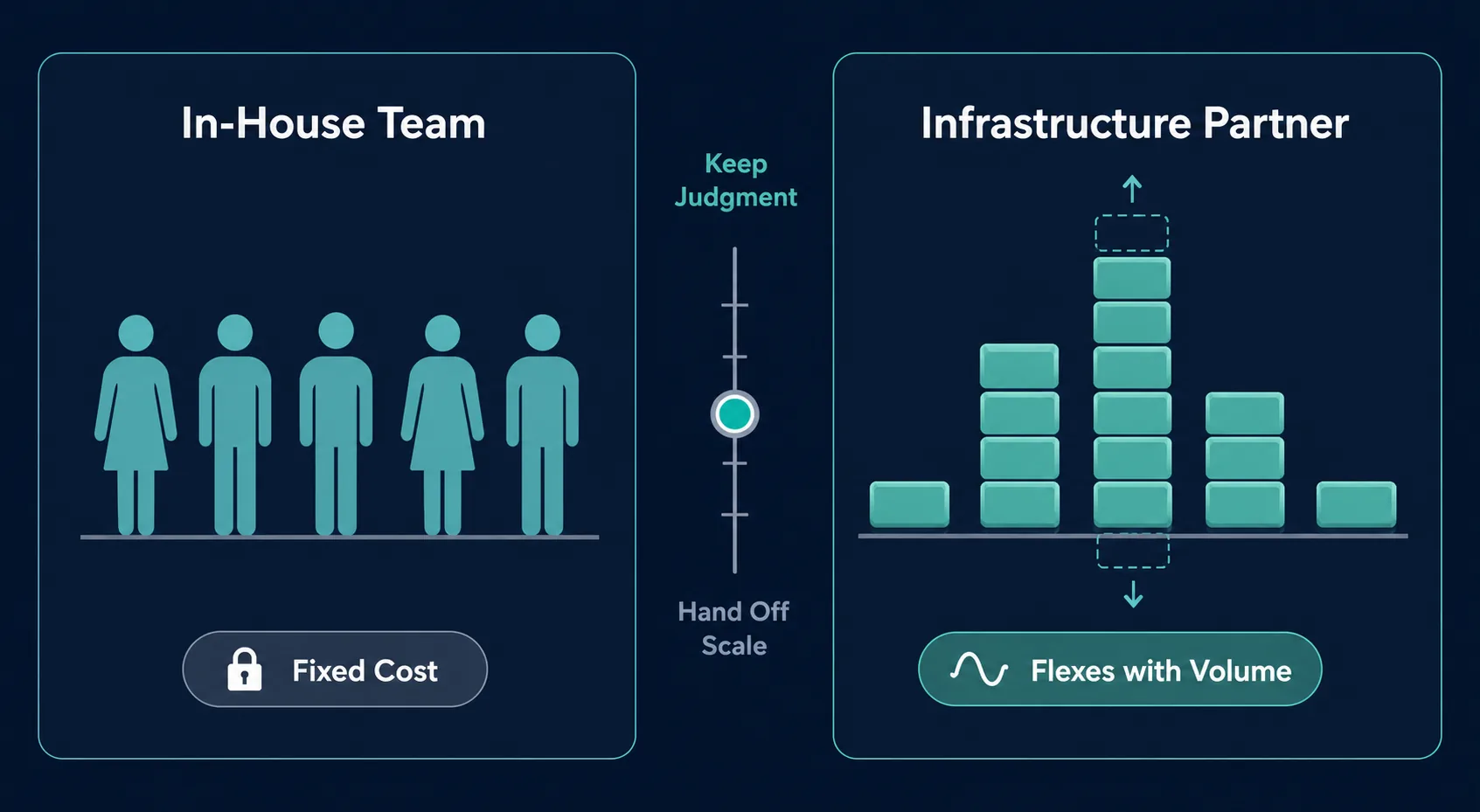
Every hire adds fixed cost, three to six months of ramp, and a new dependency. What it does not add, on its own, is a second set of eyes, a repeatable process, or an audit trail.
Complexity is the real driver. Unitranche, delayed draws, revolvers, multi-currency facilities, SPV structures, and asset-backed lines each carry their own servicing calendar, notice mechanics, and failure modes. Volume you can staff for. Variety you cannot, at least not cheaply.
The asset class is also under a brighter light. Federal Reserve staff analysis of bank lending to private credit traces how deeply nonbank lending now connects back into the banking system, which is one reason operational evidence gets asked about earlier in a fundraise than it used to.
Run one number before you do anything else: fully loaded operations cost per active facility, per month. Then project it at two times your current deal count. If that number rises instead of falling, you have a process problem wearing a staffing costume.
The four things that actually consume your ops hours
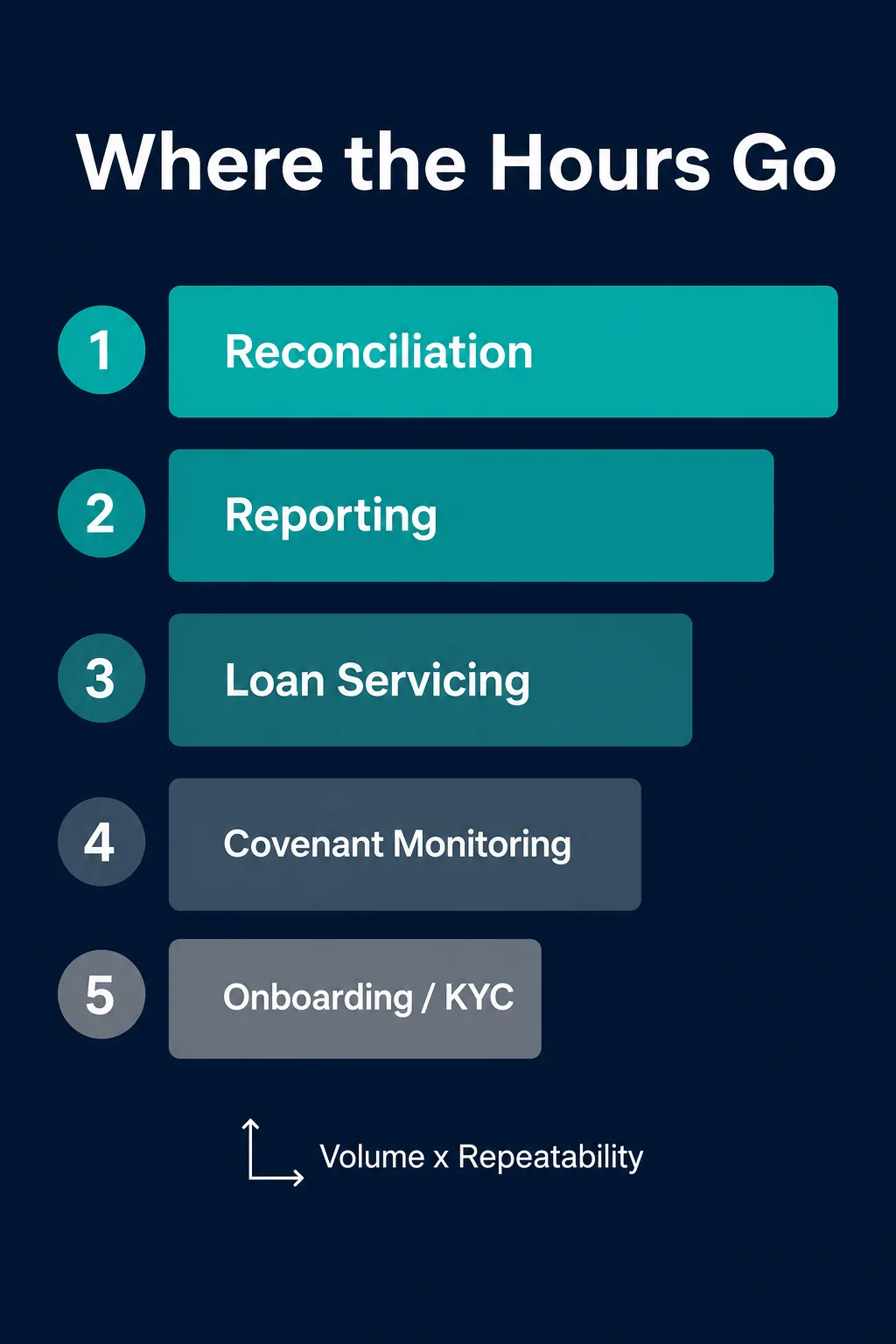
Credit agreement abstraction and covenant tracking
One-time extraction, then perpetual monitoring. It is the work most dependent on someone having seen the structure before, and the work most often trapped in one person’s head.
Notice processing, interest calculations, and cash reconciliation
High frequency, rules-based, deadline-bound. Errors here are expensive and quiet. Nobody notices a slightly wrong accrual until a lender does.
Investor and lender reporting packages
Month-end compression. This work expands to fill whatever time remains, which is why it always feels like a headcount issue.
Data normalization across strategies and systems
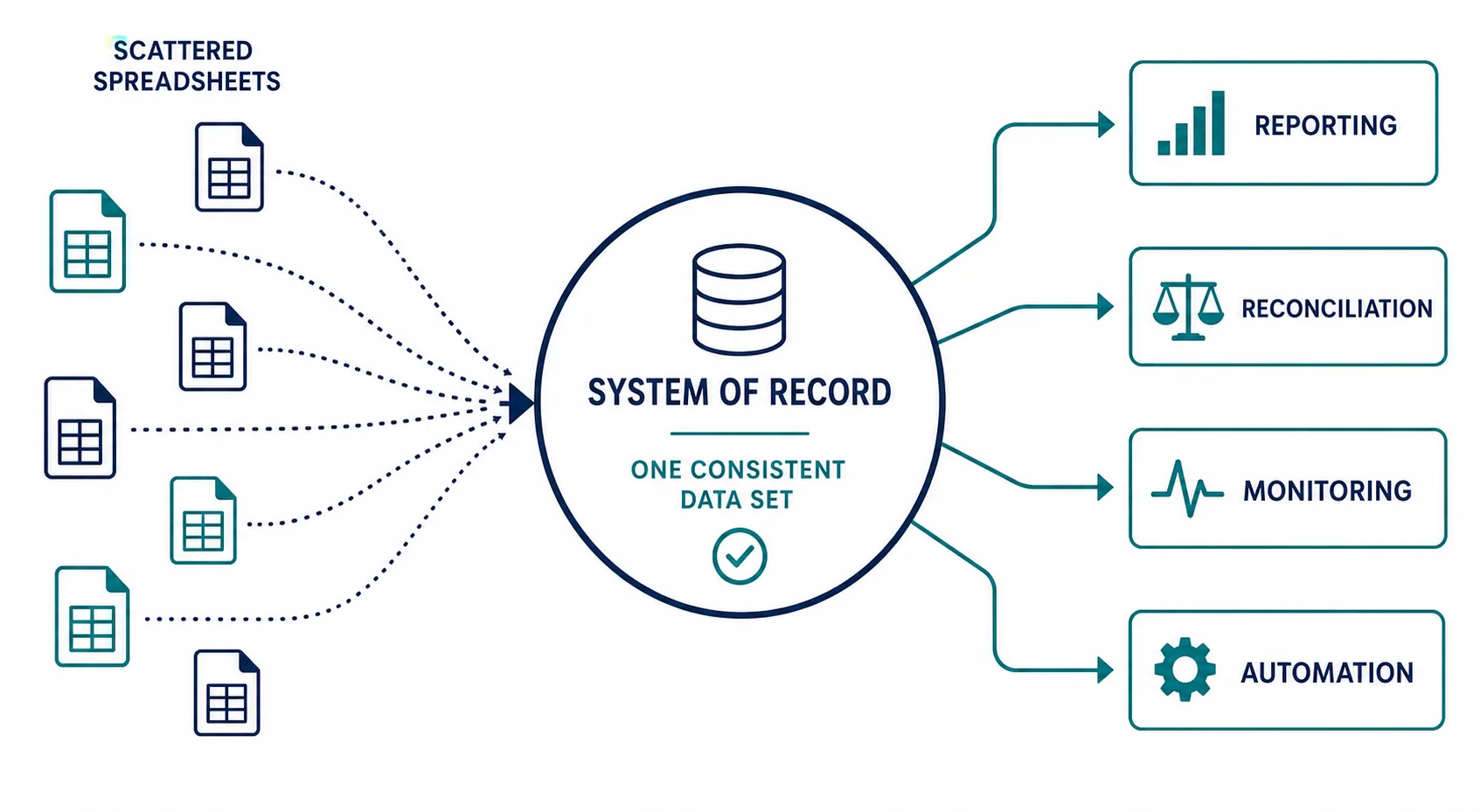
The silent tax. Every new sub-strategy arrives with a new data shape, and reconciling it by hand is usually what finally triggers the hiring request.
Three of those four are process problems, not capacity problems. A new hire absorbs the symptom and leaves the cause where it was.
Automate, outsource, or keep in-house
Apply three tests to every recurring workflow.
| Approach | Fits work that is | Examples |
|---|---|---|
| Keep in-house | Investment judgment | Credit decisions, underwriting, workout strategy, LP relationships |
| Automate | High volume, rules-stable, and low exception, provided the underlying data is clean | Interest schedules, standard notice generation, position rollforwards, recurring report assembly |
| Outsource | Complex, exception-heavy, and deadline-driven | Exceptions that depend on pattern recognition across hundreds of deals |
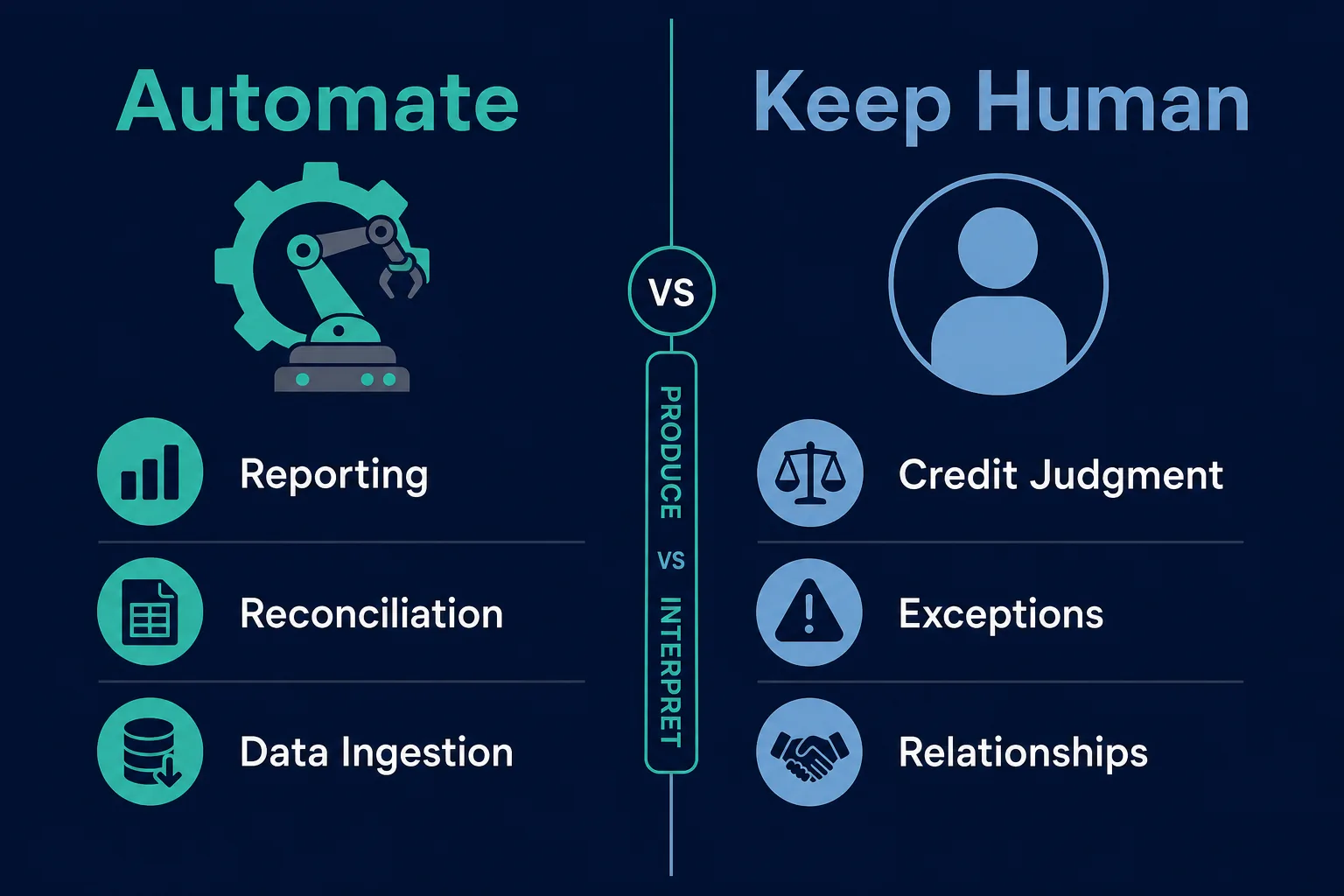
Keep in-house anything that is investment judgment. Credit decisions, underwriting, workout strategy, LP relationships. Judgment does not outsource, and no operating model should ask it to.
Automate what is high volume, rules-stable, and low exception, provided the underlying data is clean. Interest schedules, standard notice generation, position rollforwards, recurring report assembly.
Outsource what is complex, exception-heavy, and deadline-driven. This is the counterintuitive one. Most managers assume the hardest work should stay closest to home. But exceptions are precisely what a generalist new hire gets wrong, because handling them well depends on pattern recognition across hundreds of deals rather than familiarity with a handful of yours.
Almost nobody lands on a pure answer. Software alone still needs someone who has seen an esoteric structure before and knows which clause governs. People alone are expensive and slow. Purpose-built technology operated by subject matter experts is what produces cost-effective scale, along with reporting that is more transparent and more accurate than a spreadsheet-plus-heroics model can sustain.
External verification is a scaling tool, not just a control
Most writing on this topic files oversight under compliance cost. That undersells it.
When an external party is checking that transactions are monitored and recorded properly, your internal team stops spending its capacity self-auditing. That reclaimed time is real capacity, and it arrives without a req.
It matters commercially too. Institutional allocators expect institutional-grade infrastructure and genuine segregation of duties regardless of fund size, and the market-wide push for better exposure data reinforces it. The Office of Financial Research has documented how hard counterparty exposures in private credit are to measure with existing data, which is the visibility gap diligence questions are aimed at. Operational maturity is diligence surface area now, not back-office trivia.
Scaling into new strategies without rebuilding the team
The pattern repeats. A manager wins a mandate adjacent to its core (asset-backed finance, specialty finance, sponsor finance, a special situations sleeve) and discovers the ops model does not extend. So it hires a pod. Then it wins another mandate.
The alternative is an operating partner whose expertise already spans the strategies you might move into next. You are not buying labor for the deal in front of you. You are buying the option to say yes to the next one without a six-month build. For managers whose growth comes from strategy expansion rather than pure volume, that optionality is usually worth more than the direct cost savings.
A 90-day checklist to scale without a req
Your 90-day plan
Scale operations without opening a req
0 of 8 done
Tick each step as you complete it. Your progress is saved in this browser only.
Why this is on the agenda now
Nonbank lending has grown quickly, bank exposure to private credit has grown alongside it, and both allocators and regulators are asking sharper questions about data quality and exposure measurement. Operational rigor is cheap to skip in good conditions and very expensive to lack when conditions turn.
Frequently asked questions
Can you really scale private credit operations without hiring?
What is a middle office in private credit?
What should stay in-house when you outsource operations?
Which operations work should be automated, and which outsourced?
How do you know whether hiring is the right answer?
How does external verification help operations scale?
Where to start
The choice is not staff or do not staff. It is whether you add cost linearly forever or change the operating model once. If deal count is growing faster than ops capacity, the useful next step is a short conversation about current volume, strategy mix, and where the bottleneck actually sits. That diagnosis takes about an hour and can save a year of hiring you did not need.
OBI Ask OBI about this article
Answers come only from the article above. For your own facility, request a consultation.
OBI answers from this article only. It can make mistakes and is not financial, tax, legal or investment advice.
Keep reading
All articles →



The team behind these articles
Reviewed by people who run private credit operations
Every article on this blog is researched, reviewed and edited by the Oak Branch team before it is published: senior professionals across private credit, asset-based lending, structured finance, operations and technology.
- Reviewed for accuracy by senior practitioners
- Figures linked to their published sources
- Written for the people who run facilities day to day
About Oak Branch Advisors
Technology-enabled middle office support, loan administration and portfolio surveillance for private credit funds, lenders and borrowers, powered by our PCS/1 platform.