

Short on time?
OBI, our AI assistant, gives you the key points of this article in a few lines.
OBI answers from this article only. It can make mistakes and is not financial, tax, legal or investment advice.
An executed credit agreement is a legal instrument and an operating manual at once. Every payment date, margin step-down, covenant level and prepayment trigger your team has to administer for the next five years sits in there, spread across a few hundred pages, a definitions article, four schedules and whatever amendments have landed since close.
Credit agreement data extraction pulls those terms out as structured fields your systems can calculate on. Done well, it replaces the manual abstract an analyst builds once and nobody updates. Done poorly, it produces a confident wrong number that flows quietly into compliance testing and investor reporting.
What Credit Agreement Data Extraction Actually Means
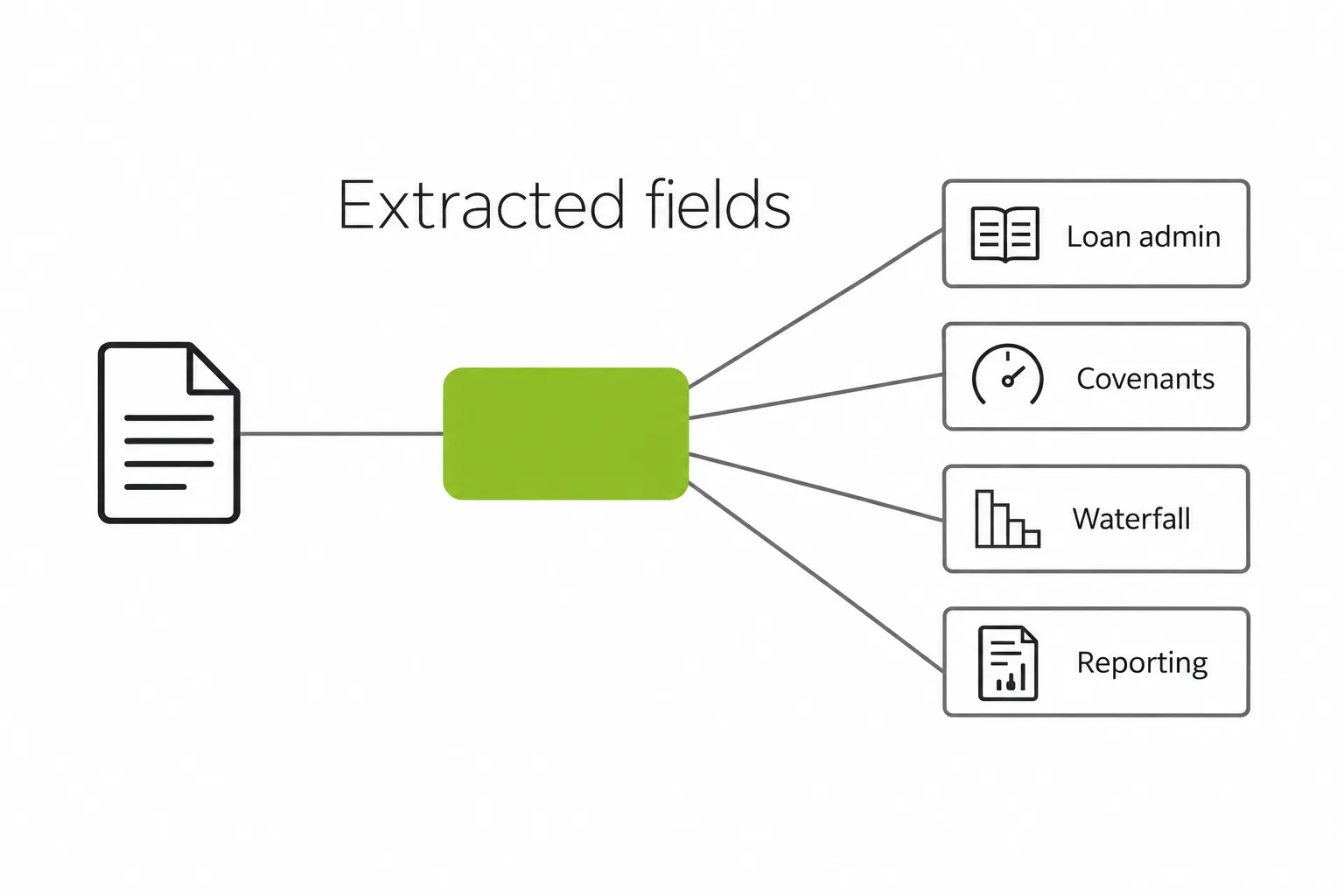
Extraction converts an executed agreement, its amendments and related loan documents into typed, queryable values: dates as dates, commitments as numbers by tranche, covenant levels as a schedule of thresholds by test date. The output is JSON, a table, or records in a loan administration system.
That is not storage. A contract repository with full-text search tells you which document mentions “Consolidated EBITDA.” It does not tell you what the current leverage covenant is, whether it steps down in Q3, or which of three tranches the step-down applies to. Search finds documents. Extraction produces fields you can run arithmetic on.
| Contract repository | Extraction pipeline | |
|---|---|---|
| What it does | Stores and searches documents | Produces typed fields |
| What it answers | Which document mentions “Consolidated EBITDA” | What the current leverage covenant is, whether it steps down in Q3, which tranche it applies to |
| What you do with it | Find documents | Calculate, test, report |
Private credit lenders feel this more sharply than syndicated desks. Bilateral and club deals carry bespoke documentation, there is no standardized filing format, and nothing arrives pre-structured. Every deal is a fresh parsing problem.
The extracted data feeds everything downstream: loan administration, covenant compliance tracking, borrowing base and collateral pool testing, waterfall calculations, transaction surveillance, investor and board reporting. Wrong at the top means wrong in all of them.
The Fields Worth Extracting and What Each One Drives
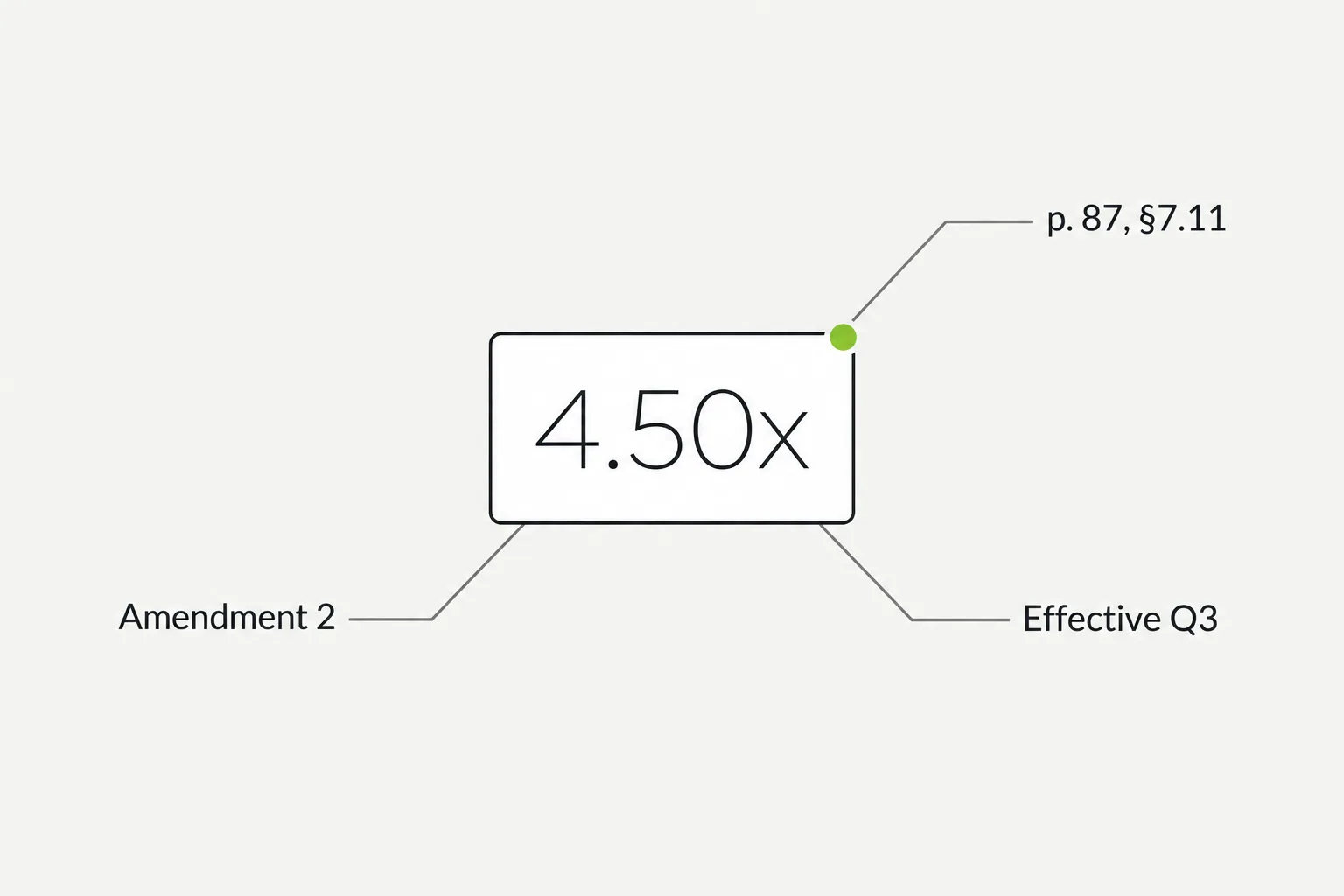
Organize the field taxonomy by what each value feeds, not by where it sits in the document. That is how an operations team actually consumes it.
| Field group | What to capture | What it drives |
|---|---|---|
| Parties and roles | Borrower, guarantors, sponsor, agents, lenders of record, assignment and participation mechanics | Notices, positions, transfer workflow |
| Facility structure | Facility type, commitments by tranche, currency, closing date, maturity, availability periods, DDTL expiry, unused fee | Funding capacity, fee accruals |
| Pricing | Benchmark and tenor, margin, grid tiers and step-downs, PIK toggle, floors, default rate, OID and fees, fallback language | Every interest calculation |
| Amortization and cash mechanics | Scheduled amortization, excess cash flow sweep, prepayment triggers, call protection, payment dates, day-count | Cash flow modeling, scenario forecasting |
| Covenants | Maintenance tests with levels and step-downs, test dates, incurrence tests, EBITDA add-back caps, reporting deadlines | Compliance calendar |
| Baskets and negative covenants | Debt incurrence caps, restricted payments, asset sale limits, investment, builder and grower baskets | Consent decisions, borrower capacity questions |
| Defaults and remedies | Events of default, cure rights, cross-default thresholds, grace periods, acceleration | Default and cure handling |
| Metadata (every field) | Source page and clause citation, effective date, amendment number, confidence flag | Proof of where a value came from |
Parties and roles.
Borrower, guarantors, sponsor, administrative agent, collateral agent, lenders of record, plus assignment and participation mechanics. Drives notices, positions and transfer workflow.
Facility structure.
Facility type (term loan, delayed draw term loan, revolver, forward flow), commitment amounts by tranche, currency, closing date, maturity, availability periods, DDTL commitment expiry, unused commitment fee. Drives funding capacity and fee accruals.
Getting that fee right depends on the formula and day-count convention, as the unused line fee calculation guide shows.
Pricing.
Benchmark and tenor, applicable margin, pricing grid tiers and step-downs, PIK toggle mechanics, benchmark floors, default rate, OID and the fee schedule, plus benchmark replacement and fallback language. Drives every interest calculation you will run on the deal.
Once benchmark, tenor, floor, and margin are extracted, you can calculate SOFR loan interest with three different methods.
Amortization and cash mechanics.
Scheduled amortization, excess cash flow sweep percentages, mandatory prepayment triggers, prepayment premiums and call protection, payment dates, day-count convention. Drives cash flow modeling and scenario forecasting.
Covenants.
Financial maintenance tests with levels and step-downs, test dates, incurrence tests, EBITDA definition components and add-back caps, reporting covenants and delivery deadlines. Drives the compliance calendar.
Baskets and negative covenants.
Debt incurrence caps, restricted payments, asset sale limits, investment baskets, builder basket mechanics, ratio-based grower baskets. Drives consent decisions and capacity questions from borrowers.
Defaults and remedies.
Events of default, cure rights and equity cure limits, cross-default thresholds, grace periods, acceleration mechanics.
One layer is easy to skip and makes the rest usable: metadata per field. Source page and clause citation, effective date, amendment number, confidence flag. A value without provenance is a value nobody will stand behind when an LP asks where it came from.
How Credit Agreement Data Extraction Works: The Six-Stage Pipeline
Six stages, each with a distinct failure mode. Knowing which stage a tool is weak at tells you more than any headline accuracy number.
| Stage | What happens | Where it fails |
|---|---|---|
| 1. Ingestion | OCR, layout and table structure preserved | OCR sets the ceiling; flattened tables pull a margin from the wrong row |
| 2. Semantic parsing | Defined terms and cross-references resolved | Rigid templates return nothing or the wrong thing |
| 3. Amendment chains | Every field effective-dated, with supersession logic | An old document overwrites a newer repricing |
| 4. Source grounding | Each value linked to clause, page, version, with confidence score | No provenance or confidence means reviewing every field or none |
| 5. Validation and review | Machine checks, reconciliation to agent notice and funding memo, human review on costly fields | Plausible but wrong values pass |
| 6. Structured output | Defined data model delivered into admin and monitoring systems | A one-off spreadsheet export recreates the original problem |
1. Ingestion and Document Representation
Native-text PDFs are straightforward. Scanned executed signature copies are not, and OCR quality sets the ceiling for everything downstream. No model recovers a character the scan lost.
Layout preservation matters more than raw character accuracy. Pricing grids, amortization schedules and commitment schedules are tables. A flattened table produces a margin pulled from the wrong row, which reads as a perfectly plausible number. Section hierarchy, the defined-term index, exhibits, schedules and annexes have to survive as structure instead of collapsing into one long text blob.
2. Semantic Parsing and Definition Resolution
A credit agreement is a closed system of defined terms. The ratio in Section 6.1 is meaningless without the definition chain behind it. Consolidated EBITDA depends on Consolidated Net Income, which depends on excluded items, which reference further definitions, some carrying caps expressed as a percentage of something defined elsewhere.
This is where LLM and NLP agents earn their place: resolving cross-references, capitalized term lookups and proviso logic through retrieval over a definition index rather than one naive pass across 300 pages. It is also why rigid templates break. One non-standard covenant structure, or a defined term relocated into a schedule, and the template returns nothing or returns the wrong thing.
3. Amendment Chains and the As-Of Problem
The gap most tools underweight. Extraction has to answer “what are the terms today,” not “what did the original agreement say.”
Real deals accumulate amendments and restatements, incremental facilities, joinders, waivers that may be permanent or one-time, repricing amendments and consent letters. Handling that requires effective-dating every field and maintaining supersession logic, so a 2023 margin does not overwrite a 2025 repricing because the original document happened to be processed last.
The correct output is a versioned field history with an as-of query, not a single flat record.
4. Source Grounding and Confidence Scoring
Every extracted value should link back to the exact clause, page and document version. A reviewer then verifies in seconds instead of rereading the agreement. That traceability is also what auditors, lenders and LPs want when they ask how a reported covenant level ties back to executed paper.
Confidence scores should route work, not decorate output. High-confidence fields pass through. Low-confidence fields queue for human review. A tool that returns values without confidence is asking you to review every field or none of them.
5. Validation, Reconciliation and Human Review
Machine checks catch a useful share of errors: type validation, date logic (maturity after closing), arithmetic (tranche commitments sum to the total facility), grid tier continuity, cross-field consistency.
Reconciliation catches a different class, values that are internally consistent but still wrong. Compare extracted terms against the agent notice, the funding memo and the closing flow of funds.
Then concentrate human review on fields where an error is expensive (covenant levels, the margin grid, maturity, prepayment triggers) rather than spreading it evenly. Reviewer corrections should become permanent test cases, not one-off fixes in somebody’s spreadsheet.
6. Structured Output and System Delivery
Output belongs in a defined data model, delivered into loan administration and portfolio monitoring systems, the covenant compliance calendar, and the data aggregation layer feeding investor reporting. A one-off spreadsheet export recreates the original problem in a new file.
After delivery, a loan data tape review confirms the tape still matches the executed terms.
Extraction is the starting point. Borrower financials and compliance certificates then get tested against those terms every reporting period.
Where Credit Agreement Data Extraction Quietly Fails: The Silent Error Problem
The dangerous output is not a blank field. Blanks get noticed.
The dangerous output is a plausible wrong value that passes review because it looks like the sort of number that belongs there.
Misses cluster in predictable places:
| What gets missed | What goes wrong |
|---|---|
| Current pricing grid tier | Opening margin is captured, or a step-down is missed |
| Incurrence vs. maintenance covenant | Modern documents carry both and the language rhymes |
| EBITDA add-back caps | Headline EBITDA is captured without the caps that constrain it |
| DDTL commitment expiry | Unavailable capacity shows as available |
| Cross-default thresholds and grace periods | Misread terms |
| Multi-currency and multi-tranche facilities | Same field name recurs with different values |
The consequence chain makes this worth engineering against. A wrong covenant level flows into compliance testing, then into borrowing base availability, then into investor reporting, and surfaces at the worst possible moment.
It is also why volume-based accuracy claims mislead. Run the arithmetic on any headline percentage: a tool that misses five percent of fields on an abstract carrying 400 of them is handing you roughly 20 wrong values per agreement.
Misses are not distributed evenly by importance either. Party names extract easily. Pricing grids and nested covenant definitions do not.
How to Test a Credit Agreement Data Extraction Tool Before You Trust It
You can run this evaluation yourself, before any purchase decision.
| Step | What to do |
|---|---|
| Build a gold set | 10 to 15 closed deals: clean bilateral, sponsor deal with full definitions, 3+ amendments, multi-currency, asset-based or specialty finance |
| Score three outcomes | Correct, missing, silently wrong. Weight silent errors heavily |
| Weight by consequence | Maturity, tranche commitments, margin grid, covenant levels, prepayment triggers over notice addresses |
| Test the amendment chain | Ask for terms as of a historical date and as of today |
| Check grounding | Every field should link to its clause |
| Rehearse on public agreements | Use agreements filed as material contract exhibits before exposing confidential documents |
| Ask about failures | Who reviews exceptions, on what turnaround, and who is accountable for the reported number |
Build, Buy or Outsource the Function
Credit agreement data extraction comes in five broad categories, each with a different trade-off.
| Option | What you get | Trade-off |
|---|---|---|
| General-purpose IDP and OCR | Strong ingestion | Legal semantics are left to you |
| LLM extraction toolkits | Maximum control | Prompt maintenance, review workflow, exception handling forever |
| Point solutions | Fast deployment | Often template-bound, which shows on non-standard deals |
| Loan systems with embedded extraction | Data in one place | Capped by the vendor’s parser |
| Managed middle office | Reviewed data, edge cases absorbed | Ask who owns exceptions and on what turnaround |
General-purpose IDP and OCR platforms handle ingestion well and leave the legal semantics to you. LLM extraction toolkits give you maximum control, along with prompt maintenance, review workflow and exception handling forever. Point solutions for contract or covenant extraction deploy fast and are often template-bound, which shows up on your least standard deals.
Loan systems with embedded extraction keep data in one place, subject to whatever ceiling the vendor’s parser has. Managed middle office providers deliver reviewed data rather than raw model output and absorb the edge cases as part of the service.
The hidden cost of building credit agreement data extraction in-house is rarely the model. It is the review workflow, the amendment tracking, the exception queue and the ongoing data governance. That is the part that never ships.
Where the decision lands depends on deal volume, documentation variety, and whether your strategies are moving toward more complex structures.
At Oak Branch Advisors we run our own technology alongside teams who have worked through esoteric transactions, including the ones that break templates, and we deliver reviewed data with an independent check rather than handing an analyst a model output to reconcile. When managers expand into new private credit strategies, the same function scales with them instead of being rebuilt.
From Extracted Fields to Ongoing Transaction Surveillance
Extraction earns its keep when structured terms drive recurring processes.
Covenant compliance calendars populate from extracted test dates and delivery deadlines, then test against borrower financials and compliance certificates. Borrowing base, eligibility and concentration testing run off structured facility and collateral terms for asset-based and specialty finance deals.
Waterfall calculations, cash flow modeling and scenario forecasting depend on accurate payment mechanics, amortization and prepayment triggers. Time-series analytics across a portfolio only work once terms are structured consistently deal to deal.
There is an independence argument too. An outside check on agent calculations and reported positions raises reporting accuracy and gives LPs and boards something verifiable behind the numbers.
Macro conditions make this concrete without anyone needing to forecast them. When spreads move, defaults tick up or amendment activity accelerates, managers who can query portfolio terms directly answer LP questions in hours. The ones working from PDFs and stale abstracts answer in weeks.
Frequently asked questions
How accurate is AI credit agreement data extraction?
How long does it take to extract data from one credit agreement?
Can AI handle scanned signature copies?
What is the difference between a contract repository and an extraction pipeline?
How are amendments handled?
Is it safe to send confidential credit agreements to an AI vendor?
Getting Structured Loan Data Without Adding Headcount
The real choice is not manual abstraction versus automation. It is who owns the exceptions, and who is accountable when a covenant level turns out to be wrong.
Getting this right lets a manager scale deal volume cost effectively, improve reporting accuracy and transparency, and keep an independent check on how transactions are monitored instead of trusting a single unreviewed source.
A sensible way in: pick a handful of deals, including at least one genuinely complex facility, run extraction against your existing abstracts, and score the differences. If the output holds up on the hard deals, expand across the portfolio. If you want to talk through how your team handles credit agreement abstraction, amendment tracking and covenant monitoring today, we are happy to have that conversation.
OBI Ask OBI about this article
Answers come only from the article above. For your own facility, request a consultation.
OBI answers from this article only. It can make mistakes and is not financial, tax, legal or investment advice.
Keep reading
All articles →



The team behind these articles
Reviewed by people who run private credit operations
Every article on this blog is researched, reviewed and edited by the Oak Branch team before it is published: senior professionals across private credit, asset-based lending, structured finance, operations and technology.
- Reviewed for accuracy by senior practitioners
- Figures linked to their published sources
- Written for the people who run facilities day to day
About Oak Branch Advisors
Technology-enabled middle office support, loan administration and portfolio surveillance for private credit funds, lenders and borrowers, powered by our PCS/1 platform.